A New Weapon Against Antibiotic-Resistant Bacteria

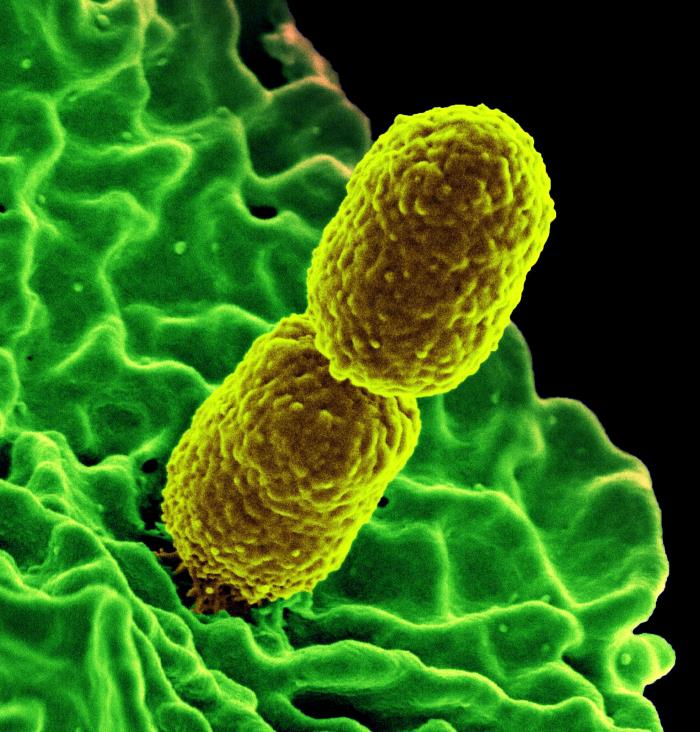
Produced by the National Institute of Allergy and Infectious Diseases (NIAID), this digitally colorized scanning electron microscopic (SEM) image, depicts two, mustard-colored, rod-shaped, carbapenem-resistant Klebsiella pneumoniae (CRKP) bacteria, interacting with a green-colored, human white blood cells (WBC), known specifically as a neutrophil.

UNIGE researchers have discovered that a medication commonly used to treat herpes can combat an antibiotic-resistant bacterium by disrupting its defense mechanisms.

Antibiotic resistance, or the ability of bacteria to develop resistance to treatment with antibiotics, has become a major concern for global health. The World Health Organization (WHO) considers it one of the greatest threats to health. The overuse of antibiotics has contributed to the emergence of antibiotic-resistant bacteria, which can cause serious illness and death. One example of an antibiotic-resistant pathogen is Klebsiella pneumoniae, a bacterium commonly found in hospitals and known for its virulence. Without effective treatment options, we could see a resurgence of diseases such as pneumonia and salmonella, which were once easily treated with antibiotics.

Researchers at the University of Geneva (UNIGE) have found that edoxudine, an anti-herpes molecule developed in the 1960s, can disrupt the protective surface of Klebsiella bacteria and make them more vulnerable to being eliminated by immune cells. The researchers’ findings were recently published in the journal PLOS ONE. 

Klebsiella pneumoniae causes many respiratory, intestinal, and urinary tract infections. Due to its resistance to most common antibiotics and its high virulence, some of its strains can be fatal for 40% to 50% of infected people. There is an urgent need to develop new therapeutic molecules to counter it.

“Since the 1930s, medicine has relied on antibiotics to get rid of pathogenic bacteria,” explains Pierre Cosson, professor in the Department of Cell Physiology and Metabolism at the UNIGE Faculty of Medicine, who led this research. “But other approaches are possible, among which trying to weaken the bacteria’s defense system so that they can no longer escape the immune system. This avenue seems all the more promising as the virulence of Klebsiella pneumoniae stems largely from its ability to evade attacks from immune cells.”

An amoeba as a model

To determine whether or not the bacteria were weakened, the UNIGE scientists used an experimental model with surprising characteristics: the amoeba Dictyostelium. This single-cell organism feeds on bacteria by capturing and ingesting them, using the same mechanisms that immune cells use to kill pathogens. “We genetically modified this amoeba so that it could tell us whether the bacteria it encountered were virulent or not. This very simple system then enabled us to test thousands of molecules and identify those that reduced bacterial virulence,” explains Pierre Cosson.

Weakening the bacteria without killing them

Developing a drug is a long and expensive process, with no guarantee of results. The UNIGE scientists, therefore, opted for a quicker and safer strategy: reviewing existing drugs to identify possible new therapeutic indications.

The research team evaluated the effect on Klebsiella pneumoniae of hundreds of drugs already on the market, with a wide range of therapeutic indications. A drug developed to combat herpes, edoxudine, proved particularly promising.“By altering the surface layer that protects the bacteria from their external environment, this pharmacological product makes it vulnerable. Unlike an antibiotic, edoxudine does not kill the bacteria, which limits the risk of developing resistance, a major advantage of such an anti-virulence strategy,” says the researcher.

Although the effectiveness of such a treatment in human beings has yet to be confirmed, the results of this study are encouraging: edoxudine acts even on the most virulent strains of Klebsiella pneumoniae, and at lower concentrations than those prescribed to treat herpes. “Sufficiently weakening the bacteria without killing them is a subtle strategy, but one that could prove to be a winner in the short and long terms,” concludes Pierre Cosson.

Reference: “5-ethyl-2’-deoxyuridine fragilizes Klebsiella pneumoniae outer wall and facilitates intracellular killing by phagocytic cells” by Estelle Ifrid, Hajer Ouertatani-Sakouhi, Tania Jauslin, Sebastien Kicka, Gianpaolo Chiriano, Christopher F. Harrison, Hubert Hilbi, Leonardo Scapozza, Thierry Soldati and Pierre Cosson, 31 October 2022, PLOS ONE.
DOI: 10.1371/journal.pone.0269093

Source

10th World Congress and Exhibition on Antibiotics and Antibiotic Resistance

February 13-14, 2023 London, UK

Focusing on Emerging Therapies and Current Research World

Meet Inspiring Speakers and Experts at our 3000+ Global Events with over 1000+ Conferences, 1000+ Symposiums and 1000+ Workshops on Medical, Pharma, Engineering, Science, Technology and Business.

Explore and learn more about Conference Series : World’s leading Event Organizer

After a successful conference of Antibiotics 2022, we are currently bringing forth “10th World Congress and Exhibition on Antibiotics and Antibiotic Resistance” (Antibiotics 2023) slated on February 13-14, 2023 London, UK. Antibiotics 2023 welcomes attendees, participants, students, speakers, organizing committee members, delegates from all over the world. We welcome you and appreciate your participation at the London, UK and it will be organized around the theme”Focusing on Emerging Therapies and Current Research Work” which includes prompt Keynote presentations, Oral talks, Poster presentations and Exhibitions.

Antibiotics 2023 will be organizing offering best platform to all academicians, researchers, industry professional, and scholars. will be scheduled on wide range of topics and it will be helpful for scientific fraternity to be connected while staying at their preferred place. Join the Physcial Conference organized by us and let the world know about your research and innovation. The Antibiotics 2023 conference hosting presentations from editors of eminent refereed journals, renowned and active investigators and decision makers in the field of Pharmacology, Infectious Diseases, Microbiology, Immunology, Bacteriology and many more. Antibiotics 2023 Organizing Committee also invites young investigators at each and every career stage to submit abstracts reporting their latest scientific research in oral and poster sessions.

We organize a series of 3000+ Global Events inclusive of 1000+ Conferences, 500+ Upcoming and Previous Symposiums and Workshops in USA, Europe & Asia with support from 1000 more scientific societies and publishes 700+ Open access Journals which contains over 50000 eminent personalities, reputed scientists as editorial board members.

Antibiotics 2023 is intended to honour prestigious award for talented Young researchers, Scientists,

Young Investigators, Post-Graduate students, Post-doctoral fellows, Trainees, junior faculty in recognition of their outstanding contribution towards the conference theme. The Young Scientist Awards make every effort in providing a strong professional development opportunity for early career academicians by meeting experts to exchange and share their experiences on all aspects of Pharmacology.

Young Research’s Awards at Antibiotics 2023 for the Nomination:

Young Researcher Forum – Outstanding Masters/Ph.D./Post Doctorate thesis work Presentation and only 25 presentations acceptable at the Antibiotics 2023.

YRF Registration benefits:

  • Our conferences provide best Platform for your research through oral presentations.
  • Share the ideas with both eminent researchers and mentors.
  • Young Scientist Award reorganization certificate and memento to the winners
  • Young Scientists will get appropriate and timely information by this Forum.
  • Platform for collaboration among young researchers for better development
  • Award should motivate participants to strive to realize their full potential which could in turn be beneficial to the field as whole.

Why to attend?

Antibiotics 2023 is a platform to discuss and learn about the latest advancements in the field of Antibiotics and Antibiotic Resistance as the world’s consideration turned regarding the urgency of new antibiotics as the antimicrobial resistance is growing day by day. Many developed nations and International health organizations are trying to focus of the current situation and making new policies to prevent the adverse effects of Antibiotic resistance.

The 2-day conference gathers Researchers, academia, labs, Drug Manufacturers, government agencies, health professionals, hospitals, young investigators, Pharma and labs and presents their opinions through key notes, and case study presentations. This conference lays a platform for all the researchers working in the field of Antibiotics to know the latest developments and the current situation of the Antibiotic resistance problem.

World AMR Antimicrobial Congress

THE WORLD’S LARGEST AMR CONFERENCE FOR ALL STAKEHOLDERS COMBATING ANTI-MICROBIAL RESISTANCE

September 7-8, 2023 | Pennsylvania Convention Center, Philadelphia, PA

What is the World Anti-Microbial Resistance Congress?

Since 2015, the World Anti-Microbial Resistance Congress has been the go-to conference globally for all stakeholders in the AMR space to meet, brainstorm ideas and formulate initiatives that can effectively tackle antimicrobial resistance.


Join us for the World AMR Congress and get full access to the Disease Prevention & Control Summit co-located at the Pennsylvania Convention Center on September 7-8. 


Source

Appel à projet pour les missions nationales de surveillance et de prévention des infections associées aux soins et de l’antibiorésistance (mandature 01/10/23 – 30/09/28)

Santé publique France lance un appel à projet pour le renouvellement des missions nationales concernant la prévention des infections associées aux soins augmentées d’un volet relatif au bon usage des antibiotiques. Retrouvez toutes les modalités pour déposer un dossier.

Par décret n° 2017-129 du 3 février 2017 relatif à la prévention des Infections Associées aux Soins (IAS), Santé publique France, s’est vue confiée le pilotage des missions déléguées en la matière à des Centres d’appui pour la prévention des infections associées aux soins (CPias). Par Décret no 2022-1445 du 18 novembre 2022 relatif aux centres régionaux en antibiothérapie, Santé Publique France peut faire appel aux centres régionaux en antibiothérapie (CRAtb), en association avec des CPias, pour exercer des missions nationales de surveillance et d’expertise en matière de lutte et de prévention contre les infections associées aux soins et la résistance aux antiinfectieux (RATB) ainsi qu’aux centres régionaux en antibiothérapie pour exercer des missions nationales d’expertise concernant la prévention et la surveillance en matière de résistance aux anti-infectieux, en particulier l’antibiorésistance.

Le présent appel à projet vise d’une part à renouveler les missions nationales actuelles concernant la prévention des infections associées aux soins et d’autre part à leur adjoindre un volet relatif au bon usage des antibiotiques conformément aux cahiers des charges général et spécifiques.

En effet, à partir du 1er octobre 2023, les MNIAS deviendront les MNPIA (missions nationales pour la prévention des infections et de l’antibiorésistance). Les MNPIA, objets du présent appel à projets, seront les suivantes :

  • Primo : surveillance et prévention des infections associées aux soins et, de l’antibiorésistance (incluant le bon usage des antibiotiques) en soins de ville et en secteur médico-social,
  • Spares : surveillance et prévention de l’antibiorésistance (incluant le bon usage des antibiotiques) en établissements de santé,
  • Spicmi : surveillance et prévention du risque infectieux lié aux actes de chirurgie et de médecine interventionnelle,
  • Spiadi : surveillance et prévention des infections associées aux dispositifs invasifs,
  • Matis : soutien aux actions de prévention des infections associées aux soins et de l’antibiorésistance (incluant le bon usage des antibiotiques) : évaluation, formation, communication, documentation.

En savoir plus sur les MNPIA

La nouvelle mandature des MNPIA se déroulera pour une période de cinq ans. Les CPias et CRAtb seront nommés par décision de la Direction générale de Santé publique France, pour assurer ces missions nationales du 1er octobre 2023 au 30 septembre 2028.

Pour accompagner Santé publique France dans l’exercice de ce pilotage, un Comité des Missions Nationales Prévention des Infections et de l’Antibiorésistance (CominaPIA) a été mis en place auprès de sa Direction générale pour définir les missions et appuyer Santé publique France dans la sélection des nouveaux titulaires pour 2023/2028.

Modalités de candidature

Le dossier de candidature devra se conformer aux cahiers des charges général et spécifiques à leur domaine de compétence. Chaque dossier est composé de deux volets distincts :

Le volet technique et scientifique comprenant :

  • Un courrier officiel d‘acte de candidature par CPIas et par CRAtb, une note de présentation synthétique et une déclaration publique d’intérêt pour chaque responsable des CPIas et CRAtb associés à la candidature
  • Un descriptif des capacités du candidat
  • Une description des activités scientifiques et techniques, incluant pour une candidature multiple, une description claire de la répartition des activités entre les candidats
  • La liste des publications des 5 dernières années
  • Une proposition de programme de travail quinquennal pour la durée du mandat

Le volet administratif et financier comprenant :

  • Une fiche d’identité du candidat
  • Une proposition financière comprenant le budget annuel global des dépenses et des recettes prévisionnelles
  • Une proposition financière comprenant la liste annuelle des personnels rémunérés
  • Une proposition des coûts de développement informatique ou de mise à jour d’outil nécessaires ainsi que le planning de mise en œuvre associé
  • Un acte d’engagement du candidat

Ainsi que l’accord sur la candidature proposée de l’ARS ou des ARS des régions hébergeant les CPIas et CRAtb associés à la candidature. 

L’ensemble des pièces constitutives du dossier de candidature devront être complétées, datées et signées par la personne habilitée à engager la responsabilité de la (ou des) structure(s) assurant la gestion du CPias ou du CRAtb candidat. Si le dossier n’est pas signé par le représentant légal de l’établissement, il convient de joindre la délégation de signature à l’appui de la candidature.

Le dossier de candidature doit être envoyé avant le 10 mars 2023 en cliquant ici.

Pour toute demande d’information, une boite mail est à votre disposition : missions-nationales_IAS-BUA@santepubliquefrance.fr  

Documents mis à disposition des candidats :

Pour information : critères d’évaluation des candidatures

Source : Santé publique France

Online Consultation: Research and Innovation Objectives for the OH AMR Partnership

The One Health Antimicrobial Resistance partnership (OH AMR) has been identified by the European Commission as one of the European Partnerships of Horizon Europe. Currently, the Research and Innovation Objectives of OH AMR are under preparation, and we now invite researchers, stakeholders, scientists, policymakers, clinicians, patient groups, AMR-related organisations, and others to provide feedback on the elements included in the Research and Innovations Objectives.

Please activate the online survey for this purpose here: Survey: OH AMR Research and Innovation Objectives

The consultation is open until 16 January 2023.

The online consultation outcome will guide the development of the final Research and Innovations Objectives, which will be included in the OH AMR Strategic Research and Innovation Agenda.

The Research and Innovation Objectives have been developed through a number of consultations during 2022. The latest version of the document can be found here: Research and Innovation Objectives of the OH AMR Partnership (pdf, 1 MB)

For questions regarding the consultation, please contact secretariat.jpiamr@vr.se. 

About the OH AMR Partnership

In the research framework of Horizon Europe and collaboration with the member states, the European Commission has identified 49 new European Partnerships, one of which is the “One Health Antimicrobial Resistance Partnership.” 

The future One Health AMR (OH AMR) Partnership will be a joint research program co-funded by the European Commission and EU member states. The OH AMR Partnership aims to coordinate and align AMR activities and funding between countries and the European level. With a mix of EU and national public R&I funding, the OH AMR partnership will develop joint calls and activities to address the objectives of the European One Health Action Plan against AMR and the WHO Global Action Plan on AMR to reduce the burden of AMR.

For more information about the OH AMR Partnership, visit www.ohamr.eu. 

Source : JPIAMR.eu

Des chercheurs lillois ont identifié une nouvelle famille de médicaments contre la tuberculose.

La tuberculose est responsable de 1,4 million de morts par an et reste de nos jours un problème de santé publique majeur. Au cours des dernières décennies, la multirésistance croissante aux antibiotiques du bacille de Koch, ou Mycobacterium tuberculosis, a conduit l’OMS à faire de la tuberculose une urgence sanitaire planétaire. L’équipe du Dr Ruben Hartkoorn du Centre d’Infection et d’Immunité de Lille (Inserm U1019-CNRS UMR9017-Univ Lille) en collaboration étroite avec celle du Pr Nicolas Willand et du Dr Baptiste Villemagne (Inserm U1177, Univ. Lille) ont entrepris, dans ce contexte, de proposer de nouvelles alternatives thérapeutiques. Leur stratégie a démarré par le criblage phénotypique à grande échelle, d’une banque de molécules originales et conçues pour mimer les molécules naturelles. La sélection de touches, suivie de l’optimisation d’une famille chimique appelée TriSLa a permis d’identifier de puissants composés antituberculeux. Cette famille de molécules cible une enzyme bactérienne impliquée dans la chaine respiratoire et encore peu étudiée. En collaboration avec l’équipe du Dr Laurent Kremer (UMR 9004 Université de Montpellier), l’efficacité de cette nouvelle famille d’antibiotiques a été démontrée dans un modèle préclinique de tuberculose utilisant des poissons zèbre infectés. Ces résultats publiés dans la revue Journal of Medicinal Chemistry ouvrent des perspectives prometteuses dans le développement d’un nouveau traitement de la tuberculose.

Tricyclic SpiroLactams Kill Mycobacteria in vitro and in vivo by Inhibiting Type II NADH Dehydrogenases
Sushovan Dam, Salia Tangara, Claire Hamela, Theo Hattabi, Léo Faïon, Paul Carre, Rudy Antoine, Adrien Herledan, Florence Leroux, Catherine Piveteau, Maxime Eveque, Marion Flipo, Benoit Deprez, Laurent Kremer, Nicolas Willand, Baptiste Villemagne, Ruben C. Hartkoorn
J.Med. Chem. 2022 Dec 6. doi: 10.1021/acs.jmedchem.2c01493

U1019-UMR9017 “Centre d’Infection et d’Immunité de Lille”
Inserm – CNRS
 – Université de Lille – CHU de Lille 

U1177 “Médicaments et molécules pour les systèmes vivants”
Université de Lille – Inserm  

Source : Institut Pasteur de Lille

Retrouvez les présentations du Symposium interdisciplinaire sur le sepsis du 8 septembre 2022

Suite au Symposium interdisciplinaire sur le sepsis qui a eu lieu le jeudi 8 septembre dernier au Ministère de la Santé, retrouvez ci-dessous les présentations des intervenants dans l’ordre de la journée.

Le Sepsis, un problème de santé publique.

Djillali ANNANE – Université Versailles Saint-Quentin, Paris

De la mécanistique moléculaire au lit du patient.
Laurent BOYER – C3M, Inserm
U1065, Université Côte d’Azur, Nice

One Health : apport de l’animal à la lutte contre le sepsis.
Vanessa LOUZIER
– VetAgro Sup, Ecole nationale vétérinaire, Lyon

Réponse inflammatoire systémique : les leçons d’un organisme modèle.
Jean-Luc IMLER – Institut de Biologie Moléculaire et Cellulaire, Strasbourg

Diagnostic précoce du sepsis : du cabinet du médecin généraliste à l’admission à l’hôpital.

Pierre HAUSFATER – Sorbonne Université, Paris

Immunothérapie personnalisée guidée par les biomarqueurs.
Guillaume
MONNERET – Université Claude Bernard Lyon 1, Lyon

Enriched endotypes for sepsis.

Julian KNIGHT – Wellcome Trust Center for Human Genetics, University Oxford

Challenges in sepsis.

Mervyn SINGER – University College London

Avancées méthodologiques en recherche clinique : place et avenir des essais adaptatifs.

Sylvie CHEVRET – Unité de Biostatistique et de Recherche Clinique, Université Paris Cité

Recherche en oncologie : exemple de la médecine de précision. Christophe LE TOURNEAU – Department of Drug Development & Innovation (D3i), Institut Curie – Paris & Saint-Cloud – Paris-Saclay University

Long-term outcome after sepsis.

Joanne McPEAKE – University of Glasgow, Scotland

ISIDORe (Integrated Services for Infectious Disease Outbreak Research)

ISIDORe (Integrated Services for Infectious Disease Outbreak Research) financé par l’UE et coordonné par l’infrastructure européenne ERINHA, est une initiative unique entièrement consacrée à la fourniture d’un accès gratuit aux services de recherche afin d’avancer la recherche sur les agents pathogènes susceptibles de provoquer des épidémies et pandémies.

De la biologie structurelle aux essais cliniques, ISIDORe propose un portfolio intégré de services et de ressources de recherche de pointe répartis en neuf grandes catégories: services analytiques; modèles cellulaires; modèles in-vivo; immunosurveillance et profilage; soutien au développement diagnostique et thérapeutique; soutien au développement de vaccins; échantillons cliniques; conseils en matière de réglementation, préparation des essais et accès aux essais cliniques européens; sciences sociales et épidémiologie.

L’accès à plus de 300 services et installations de pointe, ainsi qu’aux équipements et aux technologies de ses154 membres est gratuit et assuré via les appels à propositions lancé par ISIDORe.

Tout scientifique, tant du milieu universitaire que du secteur privé (UE et international) est éligible et peut bénéficier de l’offre d’ISIDORe.

Lancement des appels à projet du programme de préparation aux pandémies d’ISIDORe

Suite à ses appels à propositions de réponse rapide consacrés au SRAS-CoV-2 (toujours ouvert) et au virus de la variole du singe (délai expiré), ISIDORe a lancé ses appels à propositions du programme de préparation pour un accès gratuit aux installations et services du consortium.

Afin de prévenir les pandémies futures et de faire progresser le développement des contre-mesures médicales appropriées, le programme de préparation d’ISIDORe comprend une liste d’agents pathogènes prioritaires regroupés en quatre appels à propositions visant à soutenir la recherche sur les agents pathogènes à tendance épidémique tels que :

——-

En savoir plus sur les appels à proposition d’ISIDORe

Stratégie d’accélération MIE-MN – Liste des pathogènes prioritaires

L’ANRS | Maladies infectieuses émergentes a travaillé à l’élaboration d’une liste de familles de pathogènes ayant un fort risque de déclencher une crise naturelle, accidentelle ou provoquée, afin de concentrer les efforts de préparation de la France dans le cadre de la stratégie d’accélération MIE-MN.

Dans cette liste figurent 6 types de bactéries dont deux résistantes :

Les maladies infectieuses émergentes ou ré-émergentes sont une priorité de santé publique. L’exemple récent de la pandémie de Covid-19 est l’illustration concrète de l’impact de ces maladies sur la santé mais aussi sur les économies et les sociétés. 

Dans ce contexte, la mise en place de projets de recherche ambitieux est indispensable pour mieux comprendre, prévenir et contrôler les phénomènes d’émergence des maladies infectieuses, mais également développer des contre-mesures pour diagnostiquer, protéger ou traiter les individus. Ainsi, une réponse globale et intégrée pourra être mise en place pour limiter leurs impacts. 

Pour faire face à ces enjeux, la France s’est dotée d’une Stratégie nationale d’accélération “Maladies infectieuses émergentes et Menaces nucléaires, radiologiques, biologiques et chimiques” (MIE-MN) dans le cadre de France 2030.  

Le socle scientifique de la stratégie est constitué par deux Programmes et Equipements Prioritaires de Recherche (PEPR) complémentaires et qui seront mis en œuvre en étroite collaboration sur 5 ans :

  • Un PEPR MIE, qui porte sur la prévention et le contrôle des maladies infectieuses émergentes. Il est doté de 80 millions d’euros et piloté par l’ANRS | Maladies infectieuses émergentes, en articulation avec l’ensemble de ses partenaires académiques français ;
  • Un second consacre 30 millions d’euros à la prévention des émergences zoonotiques (virus, bactérie ou parasites transmis aux humains par des animaux ou des insectes). Il s’inscrit dans l’initiative internationale PREZODE et est piloté par le CIRAD, l’INRAE et l’IRD.

Plus d’informations sur le site de l’ANRS | Maladies infectieuses émergentes

WHO Global Antimicrobial Resistance and Use Surveillance System (GLASS) 2022

Global antimicrobial resistance and use surveillance system (‎GLASS)‎ report: 2022

Download (5 MB)

Overview

The WHO Global Antimicrobial Resistance and Use Surveillance System (GLASS) was launched in 2015 to foster AMR surveillance and inform strategies to contain AMR. The system started with surveillance of AMR in bacteria causing common human infections and has expanded its scope to include surveillance of antimicrobial consumption (AMC), invasive fungal infections, and a One Health surveillance model relevant to human health. To meet future challenges, it is in continuous evolution to enhance the quality and representativeness of data to inform the AMR burden accurately. As of the end of 2022, 127 countries, territories and areas participate in GLASS. 

The fifth GLASS report, produced in collaboration with Member States, summarizes 2020 data on AMR rates in common bacteria from countries, territories, and areas. The report brings new features, including analyses of population testing coverage or AMR trends. For the first time, the report presents 2020 data on AMC at the national level. A new interactive dashboard allow users to explore AMR and AMC global data, country profiles and download the data.

This report marks the end of the early implementation phase of GLASS. In addition to presenting data collected through the latest data call, this report provides a summary of five years of national AMR surveillance data contributed to GLASS from its initiation, presents AMR findings in the context of progress of country participation in GLASS and in global AMR surveillance coverage and laboratory quality assurance systems at (sub)national level.

Patterns of antimicrobial consumption are presented by country with a particular focus on antibacterials. The report also presents the antimicrobial consumption according to the WHO AWaRe antibiotic classification, for penicillins and cephalosporines. From a One Health perspective, the report presents antimicrobial consumption data in the human sector expressed in tons to allow a comparison with antimicrobial consumption from other sectors (not included in this report). 

Supplementary Material

GLASS Data visualization dashboards

Sustainable Development Goals (SDGs) AMR indicator 

GLASS-AMR data visualization of the Global Health Observatory